
Knee Osteoarthritis, II-III Kellgren-Lawrence grade
Authors: Federico Valli1
- 1IRCCS Istituto Ortopedico Galeazzi, Milan, Italy
- Publisher
- Tiss’You
- Published
- Document ID
- #OP12FV
Version
Original English text of the study.
Source document
On this page
Key findings
- 20 outpatient participants aged between 18 and 55 years with knee osteoarthritis of Kellgren-Lawrence grade II-III received intra-articular injections of Hydrolyzed Collagen 5mg/2ml.
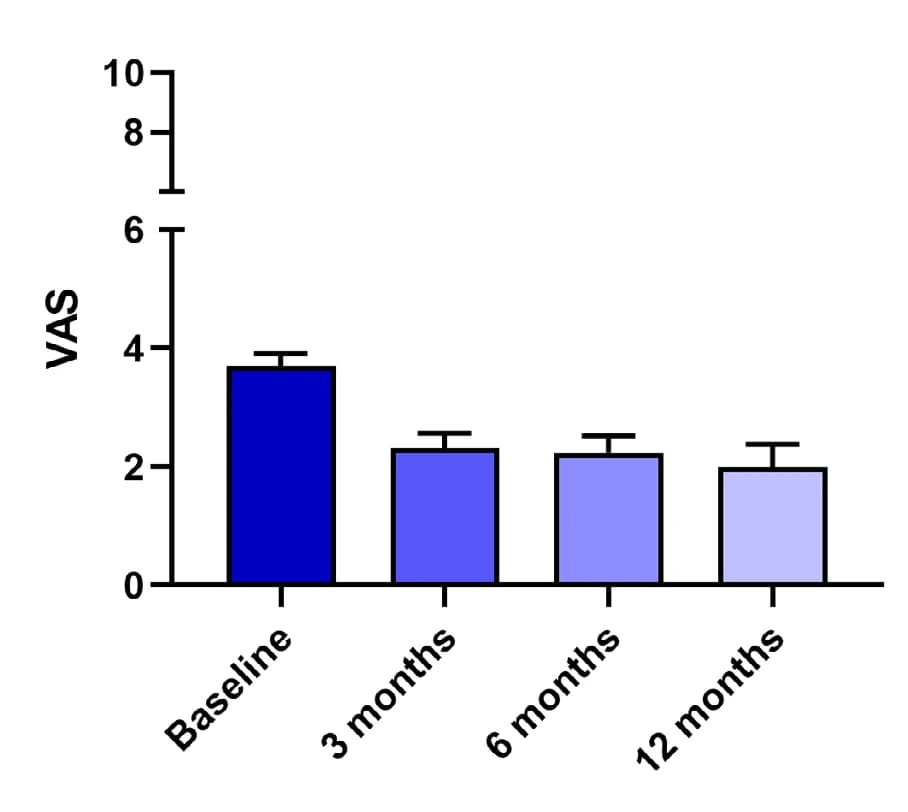
- At three months, pain alleviation (VAS) was reported in all patients and it persisted during all subsequent visits.
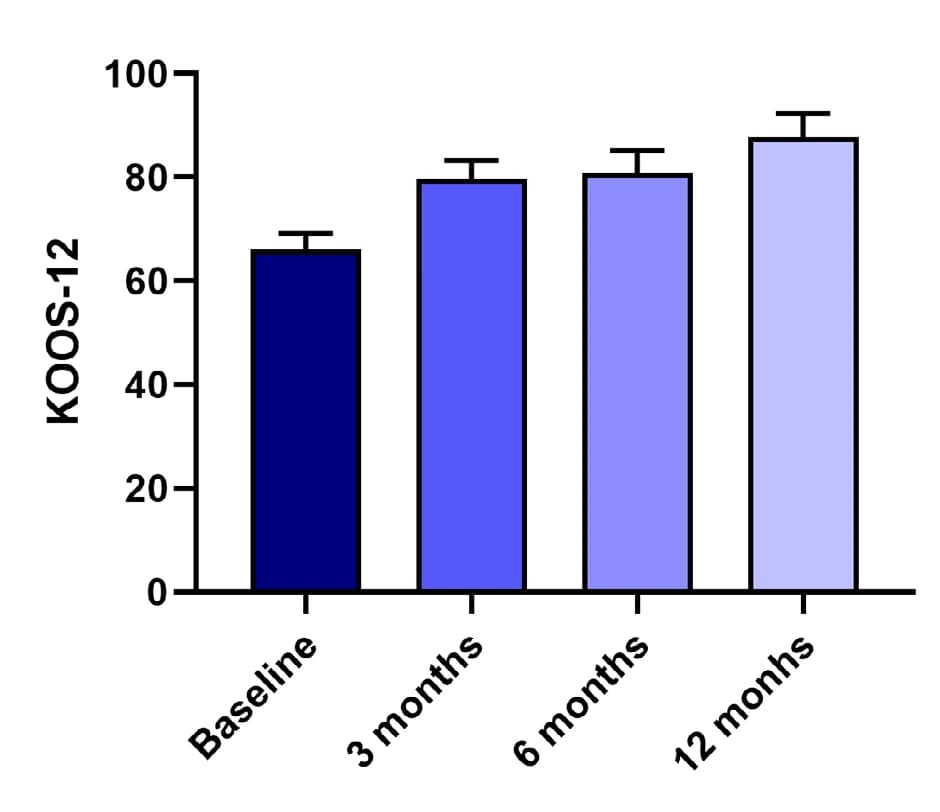
- The treated group also showed a significant functional improvement (KOOS-12), with the best outcomes at one year.
- LWPs were administered to patients only once, and the effects persisted throughout the duration of the entire investigation.
- There were no reported adverse events.
- patients
- 20
- intra-articular injection
- 1
- follow-up
- 12 months
- hydrolyzed collagen
- 5 mg/2 ml
- Indication
- Knee osteoarthritis, II-III Kellgren-Lawrence grade.
- Medical device
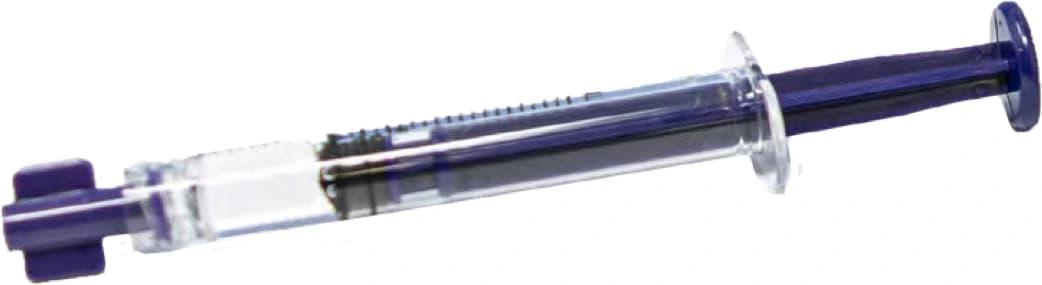
- Hydrolyzed Collagen 5 mg/2 ml. Medical device based on low molecular weight collagen peptides (LWPs). It is a ready-to-use injectable solution for the structural strengthening of connective tissues.
- Manufacturer
- Tiss’You
- Patients
- 20 patients, 34-73 years
- Investigators
- Federico Valli
- Site
- IRCCS Istituto Ortopedico Galeazzi
- Location
- Milan, Italy
- Treatment
- Knee injection, outpatient treatment.
- Follow-up
- Up to 12 months
- Report
- PMCF (Post-Market Clinical Follow-up) Report #OP12FV, 7 December 2022.
Osteoarthritis is a degenerative disease that affects joints, resulting in pain and limited mobility. Treatments range from physical work and NSAIDs administration to major surgeries; in this gap there are several minimally-invasive approaches that mostly consist in intra-articular injections, either of molecules, i.e., hyaluronic acid, or autologous blood- or fat-derived cells.
Indeed, the regenerative medicine protocols gained enormous consent in the past years, although results are dependent on the high individual variability of each patient, e.g., age, BMI, gender, smoke-habits, tissue characteristics.
Collagen peptides are a novel biological approach “from the bench” that can rely on high standardization. The low molecular weight peptides (LWPs) are obtained from the hydrolytic fragmentation of bovine collagen (Tiss’You, Republic of San Marino). LWPs can spread into the joint environment, acting as a direct reinforcement of the extracellular matrix of connective tissues deteriorated by degenerative, inflammatory, or traumatic events.
In this prospective study, the effectiveness and safety of a LWPs for the treatment of knee osteoarthritis were investigated. The device, comprising Hydrolyzed Collagen at a concentration of 5mg/2ml, was administered via intra-articular injections to 20 outpatient participants, aged between 18 and 55 years, who had knee osteoarthritis of Kellgren-Lawrence grade II-III.
The patients were interviewed at baseline, 3, 6, and 12 months to assess pain levels (assessed through Visual Analog Scale - VAS) and knee function (evaluated using KOOS-12 questionnaire). Data analysis was conducted using repeated measures analysis of variance (ANOVA) to assess changes in VAS and KOOS-12 scores over time.
At three months, pain alleviation was reported in all patients, and it persisted during all subsequent visits (Fig 1a).
The treated group also showed a significant functional improvement, with the best outcomes at one year (Fig 1b). There was continuous pain alleviation and functional improvement.
LWPs were administered to patients only once, and the effects persisted throughout the duration of the entire investigation. This implies that LWPs are a short- and long-term effective treatment for osteoarthritis. The lack of reported adverse events confirms the safety of this treatment.
Citation
Valli F. Knee Osteoarthritis, II-III Kellgren-Lawrence grade. PMCF Report #OP12FV. Tiss’You; 7 December 2022.