
Partial or small full-thickness supraspinatus tendon tears (<1 cm)
Authors: Luca Latini1 et al.
- 1Senigallia, Italy
- Publisher
- Tiss’You
- Published
- Document ID
- #OP3LL
Version
Original English text of the study.
Source document
On this page
Key findings
- VAS pain improved in 3 patients (14.3%) at T1 and in 17 patients (81%) at T2; the differences T0→T2 and T1→T2 were statistically significant (p<0.01), T0→T1 was not (p=0.07).
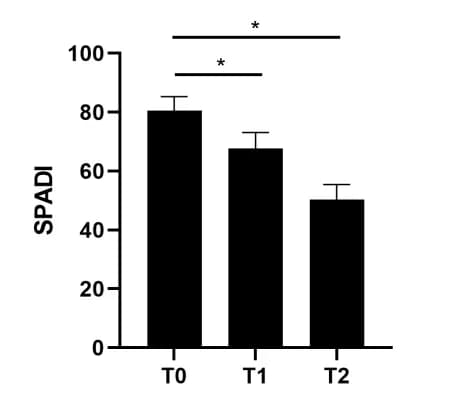
- SPADI total score improved in 13 patients (61.9%) at T1 and in 18 patients (85.7%) at T2, with statistically significant differences between T0 and T1 and between T0 and T2 (p<0.01).
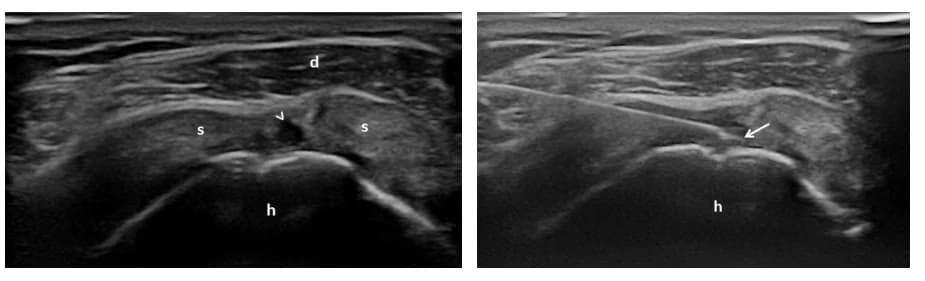
- US-guided injections were well-tolerated by all patients.
- In one patient there was no improvement in VAS pain (71 mm at T0, 71 mm at T1, 75 mm at T2); at T2, US detected progression of the tear to a maximum diameter >1 cm.
- patients
- 21
- US-guided injections
- 2
- follow-up
- 12 weeks
- hydrolyzed collagen peptides
- 5 mg/ml
- Indication
- Partial or small full-thickness supraspinatus tendon tears (<1 cm).
- Medical device
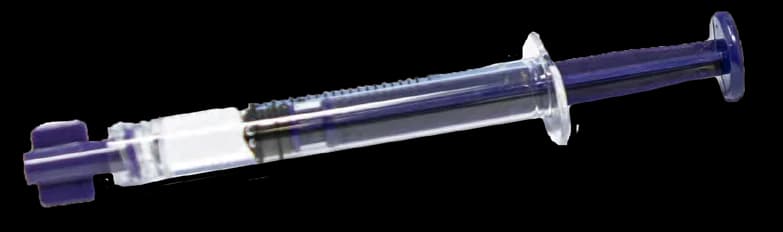
- Hydrolyzed Collagen 5 mg/1 ml. Medical device based on low molecular weight collagen peptides (LWPs). It is a ready-to-use injectable solution for the structural strengthening of connective tissues.
- Manufacturer
- Tiss’You
- Patients
- 21 patients
- Investigators
- Luca Latini et al.
- Site
- “Carlo Urbani” Hospital, Italy
- Location
- Senigallia, Italy
- Treatment
- Two ultrasound-guided injections of 5 mg/ml hydrolyzed collagen peptides: at baseline and at 2 weeks.
- Follow-up
- 2 weeks and 12 weeks
- Report
- PMCF (Post-Market Clinical Follow-up) Report #OP3LL, 14 December 2023.
Musculoskeletal pain is a major cause of disability in the Western world, with the shoulder being a frequent source of pain. Persistent shoulder pain affects both young and older individuals, especially manual workers. Its origins are often complex, resulting in high societal costs and patient suffering. Common causes of persistent shoulder pain include bursitis, tendinitis, rotator cuff tear, adhesive capsulitis, impingement syndrome, osteoarthritis, and trauma. Rotator cuff disorders account for a significant portion of shoulder pain in the general population. The ISMULT Guidelines emphasize physical and ultrasound examinations as the initial steps in evaluating shoulder disorders.
In recent decades, ultrasound (US) has gained popularity for providing rapid and non-invasive confirmation of musculoskeletal issues identified during physical examinations. This is particularly valuable for the intricate shoulder anatomy, where similar clinical presentations may arise from various structural problems. US’s real-time imaging and clear visualization make it ideal for guiding injections. Precise needle placement is crucial, especially for small targets like a partial rotator cuff tear, where anatomical references alone are insufficient.
Conservative management is the preferred initial approach for partial or small full-thickness tendon tears. Patient selection is based on specific clinical and pathological characteristics. Surgery is considered for significant acute tears or young patients at high risk of irreparable rotator cuff changes. Hydrolyzed collagen, particularly low molecular weight peptides (LWPs), has gained attention in musculoskeletal disorder treatment. However, no studies have investigated LWPs injections for supraspinatus tendon tears. Encouraging evidence from preliminary in vitro studies supports the potential of LWPs injections in tendon tear treatment.
Prospective pilot study on patients with symptomatic partial or small full-thickness supraspinatus tendon tears (<1 cm), diagnosed by US at “Carlo Urbani” Hospital, Italy. Patients were eligible if 18+, with persistent shoulder pain for ≥1 month, and confirmed partial or small full-thickness supraspinatus tendon tear (<1 cm) via US. Exclusion criteria were other shoulder pathologies, previous relevant shoulder trauma or surgery, specific rheumatic diseases, or known drug allergies.
Patients received two US-guided LWPs injections: at baseline and at 2 weeks. LWPs solution (Tiss’You, San Marino) was injected into intra-tendinous lesion under real-time US guidance. Allowed rescue medication: oral paracetamol ≤3 g/day.
Patient Evaluation was done at baseline visit (T0), first follow-up at 2 weeks (T1), and second follow-up at 12 weeks. Qualitative and quantitative data analyzed using appropriate tests. Significance considered at p < 0.01. Graph Prism used for statistical analysis.
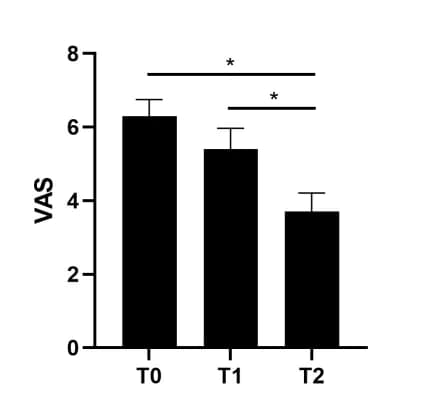
Statistically significant improvements were observed in both outcome measures of this study—VAS pain and SPADI total score—between baseline (T0) and T2. Regarding the VAS pain values at T0, improvements were seen in 3 patients (14.3%) at T1 follow-up and in 17 patients (81%) at T2 follow-up. Although no statistically significant difference was noted between T0 and T1 (p=0.07), significant improvements were observed between T0 and T2 (p<0.01) and between T1 and T2 (p<0.01) (Figure 1).
For the SPADI total score, improvements were observed in 13 patients (61.9%) at T1 follow-up and in 18 patients (85.7%) at T2 follow-up. A statistically significant difference was found between T0 and T1 (p<0.01) and between T0 and T2 (p<0.01). However, although further improvement was noted between T1 and T2, it did not reach statistical significance for the SPADI total score (p=0.08) (Figure 2).
Overall, US-guided injections were well-tolerated by all patients (Figure 3). In one case, there was no improvement in VAS pain values (71 mm at T0, 71 mm at T1, and 75 mm at T2). At the T2 visit, US detected a progression of the supraspinatus tendon tear with a maximum diameter >1 cm in size.
Tendons, crucial for muscle-bone force transmission, have complex collagen-based structures that ensure stability under load. Tendon injuries can lead to disability, and restoring their original state remains challenging.
Type I collagen dominates tendons, contributing to their mechanical strength. Tenocytes, the primary tendon cells, respond to mechanical stress, influencing tendon structure and health. Exercise-induced healthy stress supports tendon remodeling, enhancing long-term functionality. Injured tendons undergo scar formation, resulting in altered structure and weaker mechanical properties.
Recent biomaterials show promise in promoting tendon healing, especially collagen-based medical devices. Collagen peptides, administered orally or through injections, have shown effectiveness in various musculoskeletal conditions.
However, research on hydrolyzed collagen low molecular weight peptides (LWPs) injections for rotator cuff tears is limited. This PMCF study explored LWPs injections for partial rotator cuff tears, demonstrating safety and effectiveness in pain reduction and shoulder function improvement.
Citation
Latini L, et al. Partial or small full-thickness supraspinatus tendon tears (<1 cm). PMCF Report #OP3LL. Tiss’You; 14 December 2023.