
Low Back Pain – Polish Doctors Consortium, Spinal Injections
Authors: Maciej Materkowski1, Paweł Rogóź1, Cezary Rychniewicz1, Andrzej Przybycień1, Wiesław Kamiński1
- 1Polish Doctors Consortium – Spinal Injections
- Publisher
- Tiss’You
- Published
- Document ID
- #OP2PD
Version
Original English text of the study.
Source document
On this page
Key findings
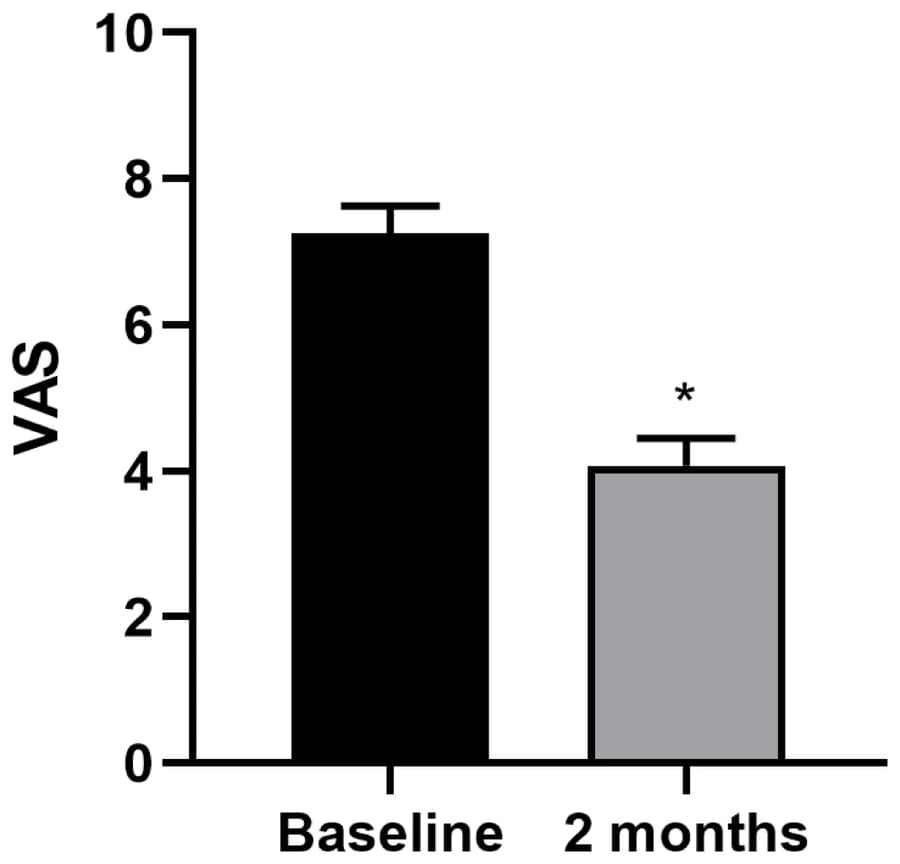
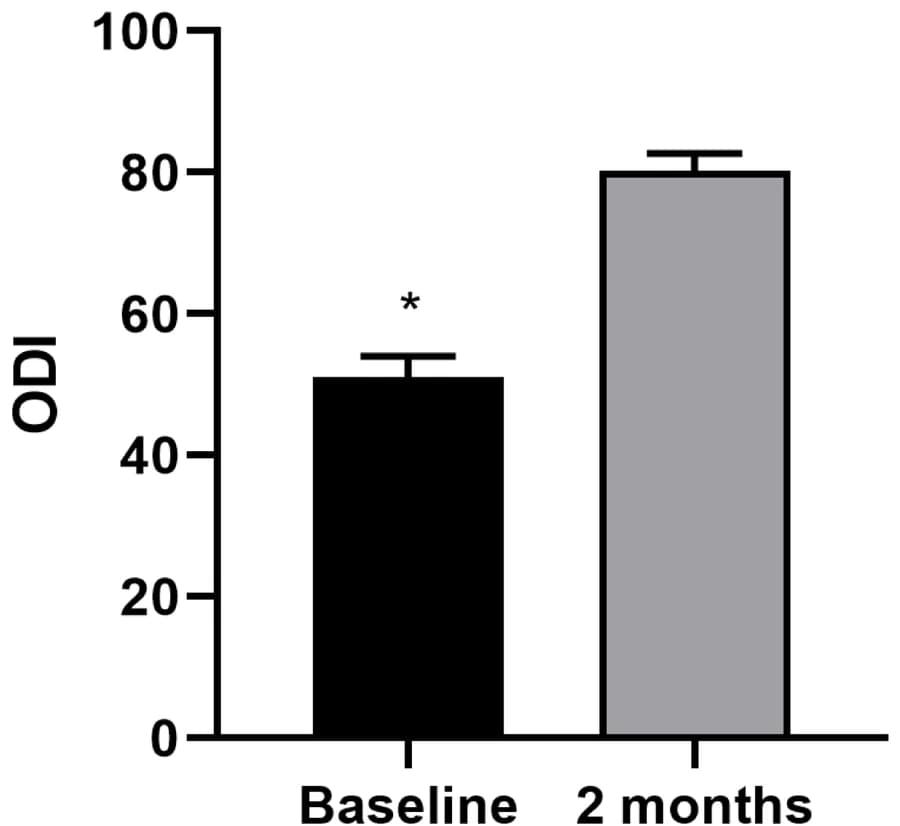
- 28 patients ranging in age from 22 to 89 years, all suffering from low back pain, were treated with intradermal injections of LWPs (Tiss’You); pain and disability were evaluated at baseline and 2 months post-treatment using VAS and ODI.
- There were no adverse events related to the injection.
- At the 2-month follow-up there was a significant decrease in pain levels measured by VAS scores and a significant improvement in disability as indicated by ODI scores (p < 0.05).
- Only two out of 28 patients reported recurrent pain and/or swelling after treatment.
- patients
- 28
- age range
- 22–89 years
- follow-up
- 2 months
- hydrolyzed collagen
- 1 mg/ml – 10 ml
- Indication
- Low Back Pain.
- Medical device
- Hydrolyzed Collagen 1mg/ml - 10ml. Medical device based on low molecular weight collagen peptides (LWPs). Ready-to-use solution for the structural strengthening of connective tissues.
- Manufacturer
- Tiss’You
- Patients
- 28 patients, 22-89 years
- Investigators
- Polish Doctors Consortium – Spinal Injections: Maciej Materkowski, Paweł Rogóź, Cezary Rychniewicz, Andrzej Przybycień, Wiesław Kamiński.
- Follow-up
- Up to 2 months
- Outcomes
- Pain and functional outcomes – VAS and ODI
- Report
- PMCF (Post-Market Clinical Follow-up) Report #OP2PD, 17 January 2024.
Low Back Pain is a symptom defined as pain between the last vertebrae and the buttock area. It is the primary cause of disability worldwide. When no underlying conditions (e.g., infection, tumor, or inflammation) are found, Low Back Pain is considered nonspecific and can be linked to various plausible anatomic nociceptive sources, including the intervertebral disc and facet joints.
Collagen peptides represent a new biological approach that can rely on high standardization. The low molecular weight peptides (LWPs) are obtained by the fragmentation hydrolytically of bovine collagen. LWPs can diffuse into the extracellular environment, acting as a reinforcing direct extracellular matrix of connective tissues deteriorated by degenerative, inflammatory or traumatic events. LWPs can also directly strengthen the matrix extracellular matrix of structures peri-articular structures, promoting the tissue healing.
In this study, 28 patients, ranging in age from 22 to 89 years, and all suffering from low back pain, were treated with intradermal injections of LWPs (Tiss’You). The main injection points included the areas below the spinous processes of the thoracolumbar region, with the needle inserted at an approximate 30-degree angle. After treatment, patients were allowed to walk immediately, as per physician instructions, but were advised to rest from strenuous activities for a recommended period of 15 days. Follow-up visits were also suggested for monitoring the patients’ progress.
To assess the effectiveness of the treatment, patients’ pain levels and disability were evaluated at baseline and 2 months post-treatment using the Visual Analog Scale (VAS) for pain and the Oswestry Disability Index (ODI). This study aimed to investigate the impact of LWPs injections on low back pain in a diverse patient group, with a particular focus on pain and disability assessments over the course of 2 months. Secondary injection points were also considered as part of the treatment protocol.
There were no adverse events related to the injection. At the 2-month follow-up, we found a significant decrease in pain levels measured by VAS scores (Figure 1) and a significant improvement in disability as indicated by ODI scores (Figure 2).
Only two out of 28 patients reported recurrent pain and/or swelling after treatment. These results support the safety and efficacy of LWPs injections for low back pain.
The study employed a specific injection protocol involving multiple injection points of 1mg/ml 10 ml collagen peptides (LWPs) to address low back pain. The results demonstrated a significant reduction in pain levels, as evidenced by the decrease in VAS scores, and an improvement in functional capacity, as indicated by ODI score improvements at the 2-month follow-up.
These findings are clinically relevant, considering the prevalence and impact of low back pain on individuals’ lives. LWPs injections offer a promising non-invasive treatment option for patients and healthcare providers seeking effective pain management strategies.
Although two patients reported post-treatment pain or swelling, the overall safety profile of LWPs injections is encouraging. Continued research and refinement of the treatment protocol may further optimize outcomes for individuals suffering from low back pain.
Citation
Materkowski M, Rogóź P, Rychniewicz C, Przybycień A, Kamiński W. Low Back Pain – Polish Doctors Consortium, Spinal Injections. PMCF Report #OP2PD. Tiss’You; 17 January 2024.