
Low Back Pain and facet syndrome
Authors: Andrea Cattalani1, Andrea Barbanera1
- 1Alessandria, Italy
- Publisher
- Tiss’You
- Published
- Document ID
- #OP3AB
Version
Original English text of the study.
Source document
On this page
Key findings
- 34 patients aged between 28 and 69 with facet joint syndrome and lower back pain were evenly divided into two groups: fluoroscopy-guided peri and intra-articular infiltrations with 2ml of LWPs, or cortisone injections, at time point 0 and again at 15/20 days.
- In both groups, an improvement of approximately 1 point on the VAS for pain was observed after the initial treatment; there was no discernible functional enhancement (ODI) during the second treatment phase at 15/20 days.
- At the 1-month and 3-month follow-ups, a substantial amelioration in both pain levels and functional outcomes was evident in both groups compared to pre-treatment conditions, statistically significant when compared to the pre-treatment timeframe.
- There were no discernible differences between the cortisone and LWPs groups, indicating comparable efficacy in pain relief and functional restoration; the most noteworthy outcomes were observed at the 3-month assessment point.
- patients
- 34
- fluoroscopy-guided infiltrations
- 2
- LWPs per infiltration
- 2 ml
- follow-up
- 3 months
- Indication
- Low Back Pain and facet syndrome.
- Medical device
- Hydrolyzed Collagen 5 mg/ml - 2 ml. Medical device based on low molecular weight collagen peptides (LWPs). Ready-to-use solution for the structural strengthening of connective tissues.
- Manufacturer
- Tiss’You
- Patients
- 34 patients, 28-69 years
- Investigators
- Andrea Cattalani, Andrea Barbanera
- Location
- Alessandria, Italy
- Treatment
- Intra- and peri-articular injections. Outpatient treatment with fluoroscopic guidance.
- Follow-up
- Up to 3 months
- Report
- PMCF (Post-Market Clinical Follow-up) Report #OP3AB, 26 February 2024.
Low back pain (LBP) is a prevalent global symptom, defined as pain in the lower back, extending from the last vertebrae to the buttocks. It is a leading cause of disability, often with nonspecific origins (meaning no identifiable underlying conditions like infection, tumor, or inflammation). Various structures, including intervertebral discs, facet joints, and surrounding tissues, can contribute to LBP. Facet syndrome, characterized by pain originating from the facet joints, is a common source of LBP – particularly in cases of chronic pain. Low molecular weight collagen peptides (LWPs) present a novel biological approach for LBP treatment. Derived from hydrolyzed bovine collagen, these peptides readily diffuse into surrounding tissues. LWPs can reinforce the extracellular matrix, as they directly support and strengthen weakened connective tissues damaged by degeneration, inflammation, or trauma.
This study aims to evaluate the safety and clinical efficacy of LBP treatment with LWPs compared to cortisone injections, specifically focusing on patients with diagnosed facet arthritis.
A cohort of 34 patients, aged between 28 and 69, diagnosed with facet joint syndrome and experiencing lower back pain, participated in this study. The patients were evenly divided into two groups, each undergoing specific treatment protocols. The first group received peri and intra-articular fluoroscopy-guided infiltrations, with 2ml of low molecular weight collagen peptides (LWPs) administered at the initial session (time point 0) and a subsequent treatment at 15/20 days. The second group also underwent fluoroscopy-guided procedures, with cortisone injections at time point 0 and a second treatment at 15/20 days. The infiltrations targeted levels such as L4-L5, L5-S1, and the sacroiliac joint. Post-treatment assessments were conducted at 1 and 3 months, utilizing the Visual Analog Scale (VAS) for pain evaluation and the Oswestry Disability Index for functional analysis.
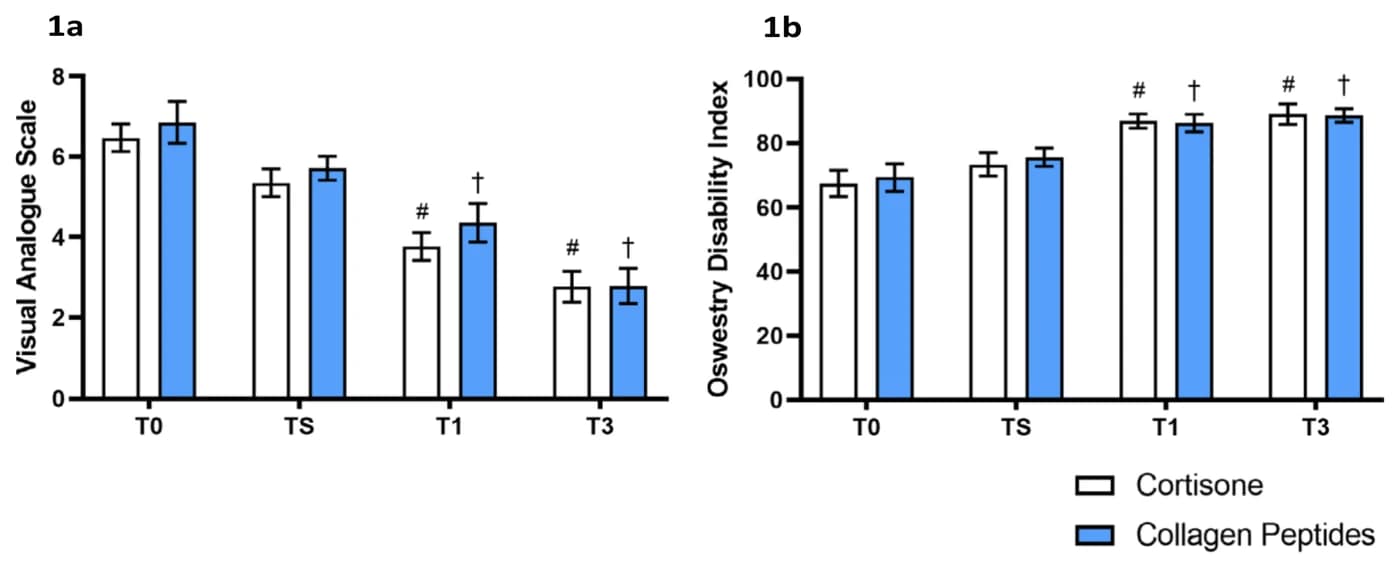
In both study groups, a notable improvement of approximately 1 point on the Visual Analog Scale (VAS) for pain was observed following the initial treatment, administered at time point 0. However, there was no discernible functional enhancement, assessed through the Oswestry Disability Index (ODI), during the second treatment phase at 15/20 days, with no significant differences noted between cortisone and LWPs interventions.
At the 1-month and 3-month follow-ups, a substantial amelioration in both pain levels and functional outcomes was evident compared to pre-treatment conditions in both groups. The improvements were statistically significant when compared to the pre-treatment timeframe, showcasing robust enhancements. Notably, there were no discernible differences between the cortisone and LWPs groups, indicating comparable efficacy in pain relief and functional restoration. The most noteworthy outcomes were observed at the 3-month assessment point, underlining the sustained and progressive nature of the observed improvements.
The observed comparable efficacy of collagen peptides interventions to cortisone in alleviating pain and enhancing functionality is a promising finding for several reasons. Firstly, LWPs represent a device rather than a pharmaceutical agent, offering a potentially safer alternative for long-term management. Given the well-documented side effects associated with cortisone, the potential of LWPs to achieve similar benefits without these drawbacks is of significant clinical importance.
Moreover, the favorable safety profile of intra and peri-articular injections, including those of LWPs, underscores their tolerability among patients. This suggests a potential advantage in terms of patient acceptance and adherence to treatment regimens.
While our results demonstrate notable improvements within a short timeframe, future investigations with extended follow-up periods would provide valuable insights into the durability and long-term sustainability of the observed effects. The consideration of longer-term outcomes is essential for a comprehensive understanding of the clinical implications of collagen peptide interventions, guiding their potential integration into broader therapeutic strategies for facet joint syndrome and lower back pain.
Citation
Cattalani A, Barbanera A. Low Back Pain and facet syndrome. PMCF Report #OP3AB. Tiss’You; 26 February 2024.